

After the Spanish-American War ended, the Philippines became a US territory which allowed for more Filipinos to migrate to the US. Many Filipino migrated for better opportunities. They moved to the Hawaiian islands, Seattle, Washington and Stockton, California.
Filipino migrants, regardless of their educational background or work experience, found jobs in the fields of the San Joaquin Delta region, including Stockton. Filipino farm workers worked long hours growing asparagus, tomatoes, celery, grapes and other crops. After work, they washed up and spent their free time in leisure activities and socializing.
Some Filipinos spent their free time either deep in the fields or behind locked doors to practice forms of Filipino martial arts (FMA): Escrima, Arnis or Kali. These farm laborers trained in secret. They did not share their art with others and sometimes their own family members did not know they were Escrimadors.
Not having their traditional weapons – swords, rattan sticks, balisong knives – these Escrimadors improvised and used what was available. Farm tools like asparagus and grape knives were adapted for their practice.
Guro (Teacher) Dan Inosanto said in his “Dan Inosanto: The Man, The Teacher, the Artist” book – as a child he had watched the agricultural workers practicing with 26-inch-long asparagus knives and heard the clang of the knives and the sticks.
In his book “Giron Escrima Memories of a Bladed Warrior,” Grandmaster Leo Giron said as a child he could hear sticks clacking and people talking in excitement and laughing behind closed doors.
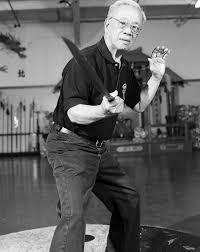
Grandmaster Angel Cabales moved to Stockton in the 1940s and worked as a foreman in the asparagus fields. Initially, he taught his Cabales Serrada art privately out of his home.
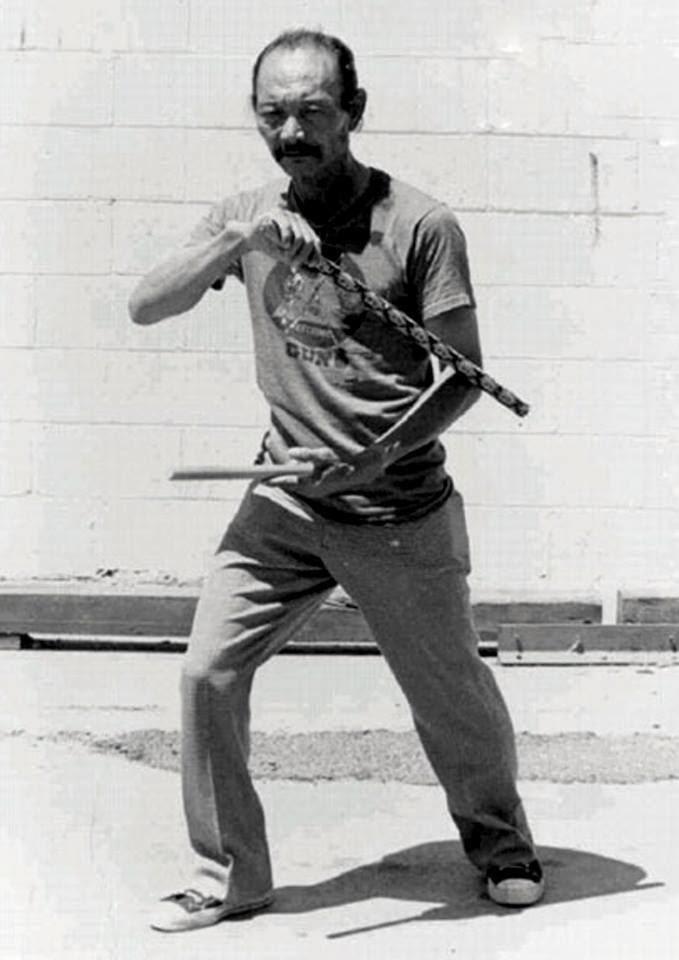
In the 1960s, with encouragement from Grandmaster Max Sarmiento and Dentoy Revillar, Grandmaster Cabales opened the first public Filipino martial arts academy and started teaching to both Filipino and non-Filipino students.
He became known as the “Father of Escrima in the US.” In the late 1960s, Grandmaster Giron, founder of Bahala Na Martial Arts Association, also opened a school to teach his art of escrima to the public.
Grandmaster Carlito Bonjoc Jr. remembered migrating to Stockton in the early 1970s. His parents worked as farm laborers. He learned his family’s martial art from his father. He also trained under Grandmaster Cabales. Grandmaster Bonjoc said in an interview that after class Grandmaster Cabales would invite his friends to come and teach — Leo Giron, Gilbert Tenio, John LaCosta and they would have their martial arts.” With many teachers sharing their art openly along with Inosanto’s book ”The Filipino Martial Arts,” they made Stockton known for Filipino martial arts.
Escrima transitioned from a secretive, closed-door combative system to a commercial defensive martial art, thanks to FMA masters like Grandmaster Cabales, Grandmaster Giron, Guro Inosanto and many others who have made FMA accessible to everyone with an interest to learn the Filipino culture, history and martial art.