


The President’s call to investigate the country’s flood control program has opened a proverbial can of worms.
Among the key revelations so far are “ghost projects,” or flood control projects that government paid even if they were not actually constructed. Bribery of lawmakers were also uncovered.
Last August 22, an official of the Department of Public Works and Highways (DPWH) was arrested in Taal, Batangas after he allegedly attempted to bribe Batangas First District Representative Leandro Leviste.
The official, DPWH District Engineer Abelardo Calalo, was caught in an entrapment operation and was subsequently taken to police custody.
Engr. Calalo allegedly offered ₱3.16 million to Rep. Leviste to dissuade him from investigating anomalous infrastructure projects in Batangas. The bribe, according to Rep. Leviste, was part of a larger scheme involving kickbacks from DPWH projects, with contractors reportedly willing to give 5–10 percent of ₱3.6 billion in district projects — amounting to ₱180–360 million annually.
The DPWH official is now facing charges of direct bribery, corruption of public officials, violation of the Anti-graft and Corrupt Practices Act and violation of the Code of Conduct and Ethical Standards for Public Officials.
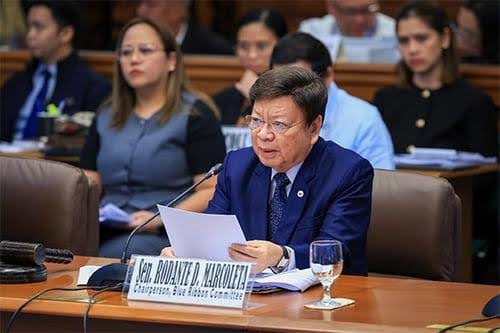
The ghost projects, meanwhile, were found mostly in Bulacan province. They were admitted by no less than the head of the DPWH, Sec. Manuel Bonoan, during a Senate Blue Ribbon Committee hearing presided by Sen. Rodante Marcoleta held earlier this August.
These ghost projects were said to be carried out between 2021 and 2022, with some continuing into 2025. The towns of Calumpit, Malolos and Hagonoy were specifically mentioned as sites of these questionable projects.
At least two contracting companies were tagged in the ghost projects controversy. They were Wawao Builders which was awarded ₱9 billion in flood control contracts nationwide, with ₱5.971 billion concentrated in Bulacan alone and SYMS Construction, implicated in several projects totaling nearly ₱1 billion.
President Ferdinand Marcos Jr. had previously flagged these contractors as part of a group that cornered a disproportionate share of the ₱545 billion flood control budget.
In his State of the Nation Address (SONA) late July, the Chief Executive delivered a fiery and candid segment on corruption in flood control projects. The topic hit especially hard as parts of Metro Manila were submerged during his speech.
Aside from ghost projects, the current investigation also unearthed license renting schemes in which smaller builders were allegedly using leased licenses from top-rated contractors (license categories AAA or AAAA). This led to substandard construction and evasion of accountability.
Probers are also digging deep into contractor monopolies as around 15 contractors allegedly cornered ₱100 billion worth of flood control contracts.
Meanwhile, the Bureau of Internal Revenue (BIR) has begun auditing contractors for possible tax evasion. Those found guilty may lose their tax clearance and be barred from future government bids.
Late this month, President Marcos Jr. personally inspected flood control sites and ordered a full probe after discovering major discrepancies. He also launched a web portal named “isumbongsapangulo.ph” to crowdsource whistleblower reports and promote transparency.
The Chief Executive has already vetoed ₱16.7 million worth of flood control projects in the 2025 budget, citing redundancy and poor placement.
Opposition senator Risa Hontiveros linked the scandal to entrenched political dynasties, arguing that elite capture of public resources fosters procurement-related corruption.
Sec. Bonoan, after an appearance in the Blue Ribbon probe by the Senate, announced that he has placed several district officials on “floating status” pending investigation. He assured that charges will be filed against those found responsible.
The DPWH secretary, however, ignored calls to step down from his post.